Built specifically for growing SMEs

Turn Complex Compliance into YourCompetitive SME AdvantageWithout the Consultant Costs!

Built specifically for ALL growing SMEs who want to master compliance and directly unlock new business opportunities!

Start Your 14-Day Trial
No credit card requiredInstant accessFull access £9.99 p.m
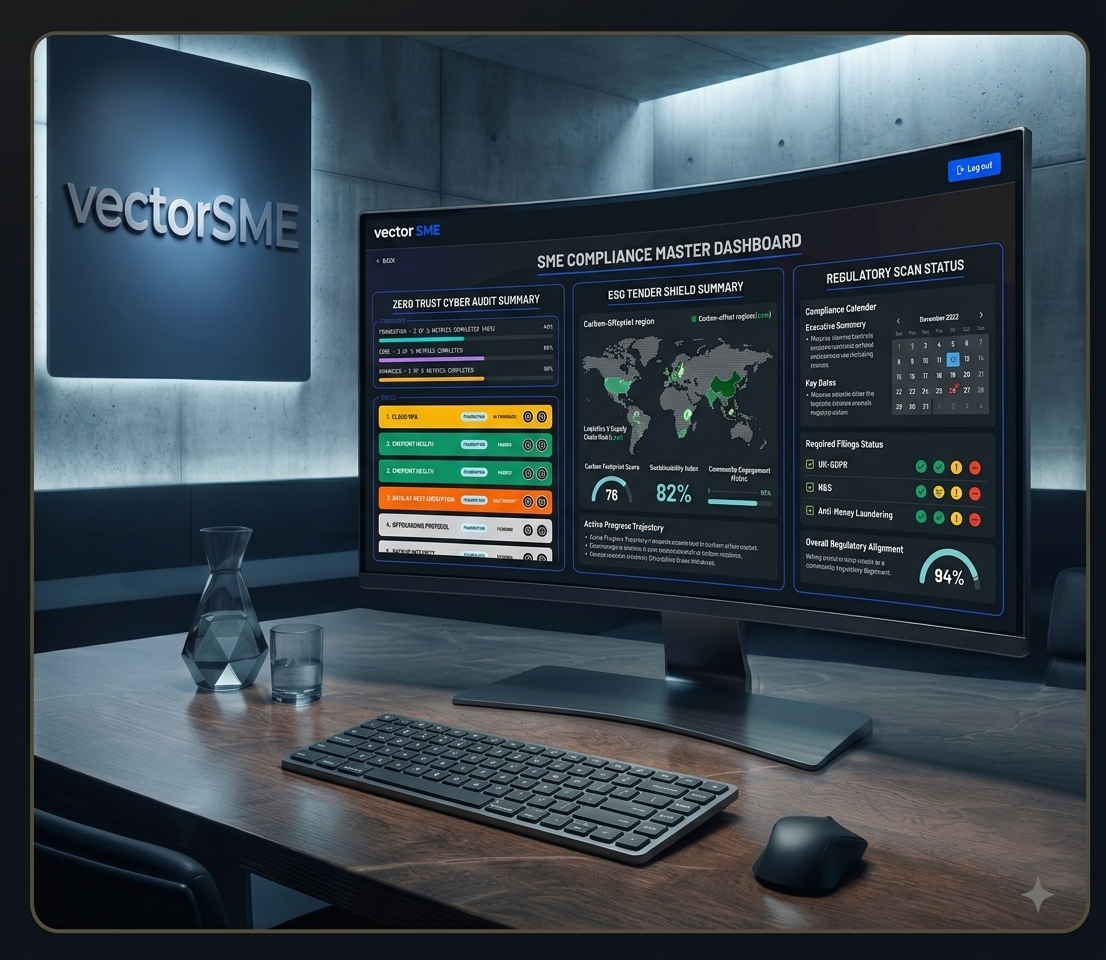
vector SME SME Compliance Master Dashboard preview

Reduce cost, win new business!

The Hidden Cost of Traditional Compliance

If you run a growing business, you shouldn't have to drown in administrative friction or stay awake worrying if a missing policy or regulatory oversight is going to cost you a major contract. Traditional compliance feels like an expensive, high-anxiety maze of red tape—and hiring part-time consultants to untangle it eats through cash fast when you're just trying to scale your operations.

The 3-Step Growth Engine

The Regulatory Shield

Walk through 40 clear, guided requirements across cyber, ESG, and regulation so you never have to guess if you're legally exposed.

Effortless Self-Certification

Instantly skip what doesn't apply to your business using smart diagnostics, cutting your workload down to the essentials.

Growth & Tender Unlock

Understand individual topics, build an immediately usable asset base, hit a 50% compliance milestone and unlock commercial tender environments and prove your reliability to enterprise clients.

"Compliance has always caused us friction, I wanted to assign the process of handling the topic to our ops manager but I needed a tool which made that feasible. vector SME offers this at the fraction of the cost of external consultants"

— Feedback from a 20-person Oxfordshire logistics team reviewing our platform.

vector SME Blog Spot

What Is the Voice of British Business Saying?

What Business Advocacy Groups report..

If you listen closely to the corridors of Westminster, the regional chambers of commerce, and the boardrooms of Britain’s enterprise networks, a unified consensus is finally emerging. Small and medium-sized enterprises are no longer being told that compliance is just a bureaucratic checkbox. They are being told that it is the single most decisive factor separating the businesses that scale from those that quietly stall.

To understand why thousands of UK small business owners feel trapped by administrative red tape — and why forward-thinking founders are turning governance into a growth engine — we invited the major institutions shaping the British economy to give their take. Here is what they are saying.

Federation of Small Businesses (FSB): “The £36 Billion Red Tape Tax”

The FSB has long been the frontline defender of the micro-business community, and their landmark policy report, Playing by the Rules, lays bare the staggering toll of administrative friction: “Complex regulatory and tax compliance processes impose multi-billion-pound friction costs on smaller firms, directly driving business anxiety and eroding margins.”

According to the FSB, UK small businesses collectively waste 379 million hours and £36 billion every year wrestling with red tape. Two in five business owners report that official guidance is nearly impossible to interpret or locate. Without dedicated legal teams, founders are forced into an impossible choice: spend valuable hours deciphering dense statutory language themselves, or bleed cash hiring external consultants. For the FSB, the mission is clear — small businesses urgently need automated, plain-English solutions that lift this administrative tax.

British Chambers of Commerce (BCC): “Squeezed Margins and Defensive Pricing”

Representing over 4,500 businesses — 91% of which are SMEs — the BCC’s Quarterly Economic Surveys track the daily operational pressures facing local companies: “Over 70% of firms cite mounting labour and overhead costs as primary price pressures, with more than half forced into defensive price increases.”

The BCC emphasises that administrative mandates, employment law updates, and regulatory compliance do not exist in a vacuum. When cumulative cost pressures mount, they directly compress operating margins. For the BCC, streamlining compliance isn’t just about avoiding penalties; it is about protecting business liquidity so that small firms can focus on pricing stability, retaining staff, and investing in long-term productivity rather than defensive survival.

techUK and DSIT: “The Cyber Governance Gap”

As the representative body for the UK tech sector, techUK — working alongside Department for Science, Innovation and Technology (DSIT) data — focuses heavily on the digital realities of supply chain risk: “Only 1 in 10 businesses systematically review risks associated with immediate tier-one suppliers, despite major corporate buyers demanding rigorous verification.”

The technology sector is booming, with public sector procurement contracts expanding significantly. However, techUK notes a dangerous disconnect: while large enterprises enforce strict Zero Trust and cybersecurity mandates down their supply chains, smaller firms lag severely behind. For techUK, adopting automated digital security baselines is no longer optional for SMEs — it is the prerequisite ticket to enter enterprise tech procurement.

Confederation of British Industry (CBI): “Unlocking the Enterprise Supply Chain”

The CBI looks at the macro-picture through the lens of national competitiveness and corporate integration: “Major corporate customers and public sector bodies are aggressively pushing risk down the supply chain via stringent audit clauses, mandatory ESG disclosures, and digital compliance checks.”

According to the CBI, big business can no longer operate in isolation from its supply network. As ESG metrics, Scope 3 carbon tracking, and ethical governance become standard corporate requirements, suppliers who cannot self-certify their compliance are systematically locked out of major contracts. For the CBI, bridging the gap between small suppliers and enterprise buyers is vital for the health of the broader UK economy.

Innovate UK & Regional Growth Hubs: “Curing Compliance Friction”

Local Growth Hubs and regional enterprise programmes see firsthand why promising startups fail to scale: “Micro and small enterprises fail to scale not due to a lack of product or service merit, but due to ‘compliance friction’ — spending excessive capital on high-cost external consultants.”

Regional development bodies point out that innovative founders are constantly held back by the administrative overhead of basic alignments like GDPR, Net Zero baselines, and public sector pre-qualification questionnaires (PQQs). Their mandate is to provide accessible, practical support that replaces expensive consultants with plug-and-play digital workflows.

The Verdict: Turning Compliance into Growth

When you synthesise the commentary from Britain’s leading economic bodies, a single, unmistakable conclusion emerges. The old way — relying on hopeful guesswork, drowning in impenetrable PDF guidebooks, or paying boutique consultants thousands of pounds for basic paperwork — is broken.

Platforms like vectorSME were built precisely to answer this institutional call to action. By acting as an audit-ready translation layer — automating your Regulatory Shield, organising your Single-Click Evidence Locker, and translating internal assets into enterprise-ready dossiers — we are turning the warnings of the nation’s business bodies into your greatest competitive advantage.

vectorSME... Your Commercial Acceleration Engine

From Chore to Competitive Edge: Why Your SME Needs a “Compliance Strategy”

For the average SME owner, the word “compliance” usually triggers the same reaction as a dental appointment. It feels like a necessary evil — a bureaucratic maze of GDPR, cyber checklists, ESG mandates, and tax filings that distract you from the work that puts food on the table.

But here is the hard truth that many sceptical SME owners are missing: compliance is no longer just a defensive chore. It is your most untapped commercial engine.

In an era where large enterprise buyers and public sector frameworks are tightening their vendor vetting, your ability — or inability — to prove you are “audit-ready” is now the single biggest factor determining whether you win or lose the next big contract.

The £36 Billion Tax on Innovation

Let’s look at the data. According to the Federation of Small Businesses (FSB), the cumulative “red tape” burden on UK small businesses is staggering: 379 million hours and £36 billion wasted every single year.

For a micro-business with 0–49 employees, that isn’t just an “administrative cost”. That is lost time that should have been spent selling, innovating, or managing your team. It is money bled into high-cost external consultants because founders are too busy to decode complex statutory language. When 41% of business owners tell us that official government guidance is nearly impossible to interpret, it is no wonder so many choose the “hopeful guesswork” strategy. But in the world of enterprise procurement, hope is not a strategy. It is a liability.

The ‘Reactivity Gap’: Why SMEs Are Getting Locked Out

Most SMEs operate in a state of reactive compliance. You don’t think about ESG carbon-reduction plans or Zero Trust cybersecurity until a potential corporate client sends you a 50-page pre-qualification questionnaire (PQQ) and expects it back by Friday.

Data shows that over 85% of smaller firms fail to track critical risks like supply chain cyber-exposure or Scope 3 ESG metrics until they are abruptly forced to during a vendor check. By then it’s often too late. You aren’t just scrambling to catch up — you are being systematically screened out by automated procurement software before a human even reviews your pitch.

This isn’t a problem reserved for major corporations. The largest retail and public sector buyers in the UK are pushing these mandates downstream. If you can’t self-certify, you don’t exist in their ecosystem.

Where Compliance Unlocks the Big Wins

  • Professional & Technical Services: proving GDPR compliance and robust cyber hygiene is your “trust badge”, cutting sales cycles from months to weeks.
  • Manufacturing & Engineering: with Scope 3 emissions reporting becoming standard for automotive and industrial OEMs, audit-ready carbon metrics capture contracts abandoned by non-compliant competitors.
  • Construction & Trades: public frameworks tie up to 20% of tender scoring to social value and environmental impact — an audited ESG Tender Shield is a 20% head start.

The Day-to-Day Struggle: DIY vs. The Consultant Trap

The average founder is stuck in a multi-portal quagmire — jumping between HMRC, the ICO, sustainability platforms, and various industry-specific accreditation sites.

Without an internal legal team, the burden falls entirely on you. You are left choosing between “DIY guesswork” — which carries the risk of crippling fines and lost credentials — or paying exorbitant fees to external consultants who charge by the hour for basic tasks. Neither option is sustainable. SMEs need automated, plug-and-play workflows that let them tick the box and get back to building their business.

Lazy? … No, Just Overwhelmed

There is a common misconception that small business owners are “lazy” about compliance. That is false. They are overwhelmed.

Data from the FSB and BCC shows that while small business owners might ignore compliance proactively, they feel the pain acutely the moment it threatens their bottom line. They are not against compliance; they are against bureaucratic inefficiency. They want help — practical, automated, and free of the jargon that has defined the space for decades.

How vectorSME Bridges the Gap

This is exactly why we built vectorSME. We aren’t creating another “compliance guide” — we are building the industry’s first “Audit-Ready Translation Layer”: the bridge between your internal business assets and the outside world of regulatory portals.

Our platform provides a “Regulatory Shield” — a set of 40+ guided requirements across Cyber, ESG, and Data Governance. We use smart diagnostics to instantly screen out what you don’t need, leaving a streamlined, actionable roadmap tailored to your size and industry.

The Competitive Advantage: An Audit-Ready Future

The true power of vectorSME lies in our “Single-Click Evidence Locker”. Instead of hunting across ten browser tabs, we group, format, and package your assets (Zero Trust security policies, GDPR Records of Processing, ESG carbon baselines) into clean folders mapped directly to the naming conventions used by major enterprise portals.

We aren’t just helping you pass a compliance test. We are helping you build a self-certified, audit-ready digital dossier you can hand to any procurement officer or auditor — eliminating the friction that stalls your growth.

Compliance is no longer a boring administrative chore. It is the gatekeeper to your next big contract. If you are ready to stop guessing and start growing, it’s time to rethink your compliance strategy.

Increase Sales Velocity - Foundational Modules First

From Compliance Friction to Commercial Velocity: Why Foundation Accreditation Unlocks Small Business Growth

For UK small and medium-sized enterprises, compliance frequently feels like an overwhelming administrative burden. Between expanding regulatory mandates, corporate supply chain questionnaires, and cyber readiness demands, business owners often struggle to identify where to focus their limited time and resources for maximum return.

To turn administrative friction into a competitive growth engine, vectorSME structures its 40 total audit sub-modules across three logical tiers: Foundation, Core, and Advanced. While Core and Advanced modules build long-term operational resilience, securing baseline accreditation across all 13 Foundation sub-modules is the single fastest way to clear commercial disqualifiers and unlock revenue growth.

Understanding the Three-Tier Framework

Organizing compliance into a prioritized roadmap eliminates guesswork and prevents SMEs from spreading themselves too thin:

  • Tier 1: Day-One Foundation (13 Sub-Modules) — non-negotiable statutory mandates, legal baselines, baseline cyber hygiene, and business continuity safeguards. It comprises 5 Zero Trust Cyber modules, 4 ESG modules, and 4 Regulatory modules.
  • Tier 2: Core Operational Security — builds on statutory baselines by establishing robust day-to-day governance, vendor vetting, waste tracking, and carbon reduction planning required to satisfy standard B2B tender requirements.
  • Tier 3: Advanced Enterprise Maturity — specialized disciplines such as Scope 3 carbon accounting, micro-segmentation, SIEM threat logging, and formal third-party audits tailored for large-scale enterprise integration.

Why Foundation Baseline Comes First

Core operational policies and Advanced certifications remain vital milestones on an SME's long-term maturity journey. However, attempting to build advanced climate resilience models or hardware-based passkey architecture while ignoring basic endpoint encryption or employment contracts leaves a business dangerously exposed.

Completing the 13 Foundation sub-modules removes the primary legal red flags, regulatory fine risks, and identity vulnerabilities that cause enterprise procurement teams to quietly drop small suppliers during initial vetting. It creates a solid, legally defensible floor upon which the rest of the business operates.

Unlocking the Business Development Engine

Achieving 100% completion across the 13 Foundation sub-modules marks a critical operational threshold. In vectorSME, reaching baseline accreditation automatically unlocks access to four dedicated Business Development Initiatives:

  • Pillar 1: The Preferred Vendor Trust Passport — verifiable proof of baseline operational and cyber hygiene that bypasses lengthy vendor security questionnaires and speeds up sales cycles with corporate buyers.
  • Pillar 2: The Tender Match & Framework Opener — alignment with public sector and Tier-1 procurement requirements, transforming mandatory bidding criteria into immediate access to framework agreements.
  • Pillar 3: The Enterprise Supply Chain ABM Target List — strategic account-based intelligence positioning accredited SMEs directly in front of corporate buyers looking for pre-vetted, low-risk supply partners.
  • Pillar 4: The Commercial Risk & Insurance Reduction Portfolio — documented evidence of core compliance and risk mitigation presented to underwriters to negotiate better insurance terms and reduce operational liability.

By prioritizing the 13 Foundation sub-modules across Zero Trust Cyber, ESG Tender Shield, and Regulatory Scan, SMEs clear their statutory liabilities, gain immediate commercial momentum, and establish the exact credentials needed to win larger contracts and scale sustainably.

Your Story

Frequently Asked Questions

How long does setup take?

Most SMEs complete their initial diagnostic and set up their primary compliance dashboard in under 15 minutes. The system is designed to be plug-and-play, immediately identifying which of the 40 requirements apply to your specific business model.

How secure is our data on the platform?

We employ enterprise-grade encryption for all data at rest and in transit. As a compliance platform, security is our foundational pillar. We operate on zero-trust architecture and regularly undergo independent penetration testing to ensure your sensitive business data remains completely isolated and secure.

Does this really make us tender-ready?

Yes. Hitting the 50% milestone on our platform generates verifiable documentation that aligns with standard enterprise procurement requirements (including baseline Cyber Essentials and fundamental ESG reporting), dramatically reducing the friction when bidding for commercial or government contracts.

Ready for High-Performance Compliance?

Access Vector SME Now

Start your 14-day free trial • Cancel anytime